Editorial team ·
Give an undated fair photograph an honest catalogue label
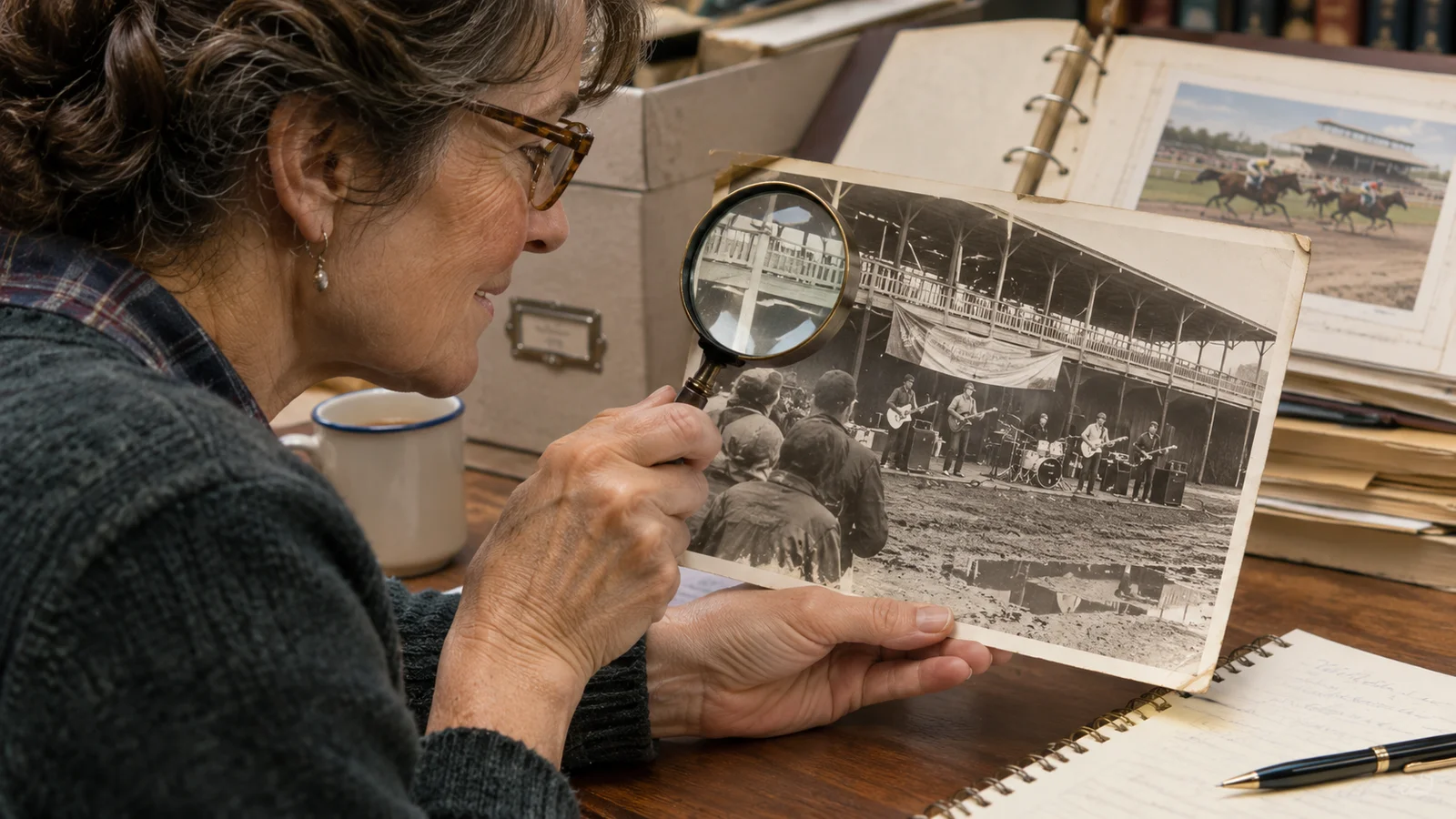
A photo shows a band outside the old grandstand. Someone remembers it from a summer when it rained all weekend. The print has no date. Begin with what you can see, then find a detail from the picture that a dated source can help place.
Write down the visible details
In the fictional archive, the grandstand bears a sign used in available fair programmes from 1974 to 1976. A banner names the band. A programme from 1975 lists that band, but the archive has no complete lineup for the other years.
You can use “possibly 1975” with a note about the programme, or a wider range if the sign evidence is stronger. A match with a single year among incomplete sources does not exclude the other dates.
Look at the back of the print. A processing date or owner’s note may tell you when the print was made or stored. If you cannot establish how close that was to the event, keep it as a clue and describe its source.
Write a label that helps a reader search again: “Band outside old grandstand, mid-1970s, possibly 1975. See matching band name in the 1975 programme.”
| Clue | What it supports |
|---|---|
| Grandstand sign | A possible period based on comparable programmes |
| Band name | A match in the 1975 programme |
| No date on the print | Exact date remains open |
Questions and answers
- Do I need a year to publish a catalogue entry?
- You can record an item as undated and give the evidence that exists.
- Is a relative’s recollection useful?
- Record it with attribution and use it to guide a search for another clue.
- Can I update the entry later?
- Yes. Link new evidence and revise the label when you have a better-supported date.
Use a range if the exact day remains open
- Describe the photograph first
- Read signs and banners in the frame.
- Check notes on the reverse.
- Explain the date estimate
- Compare with a source that carries a date.
- Label certainty, range or missing details plainly.